Who gets to set AI’s speed limit? Altman’s reported options, explained
THE SHIFT
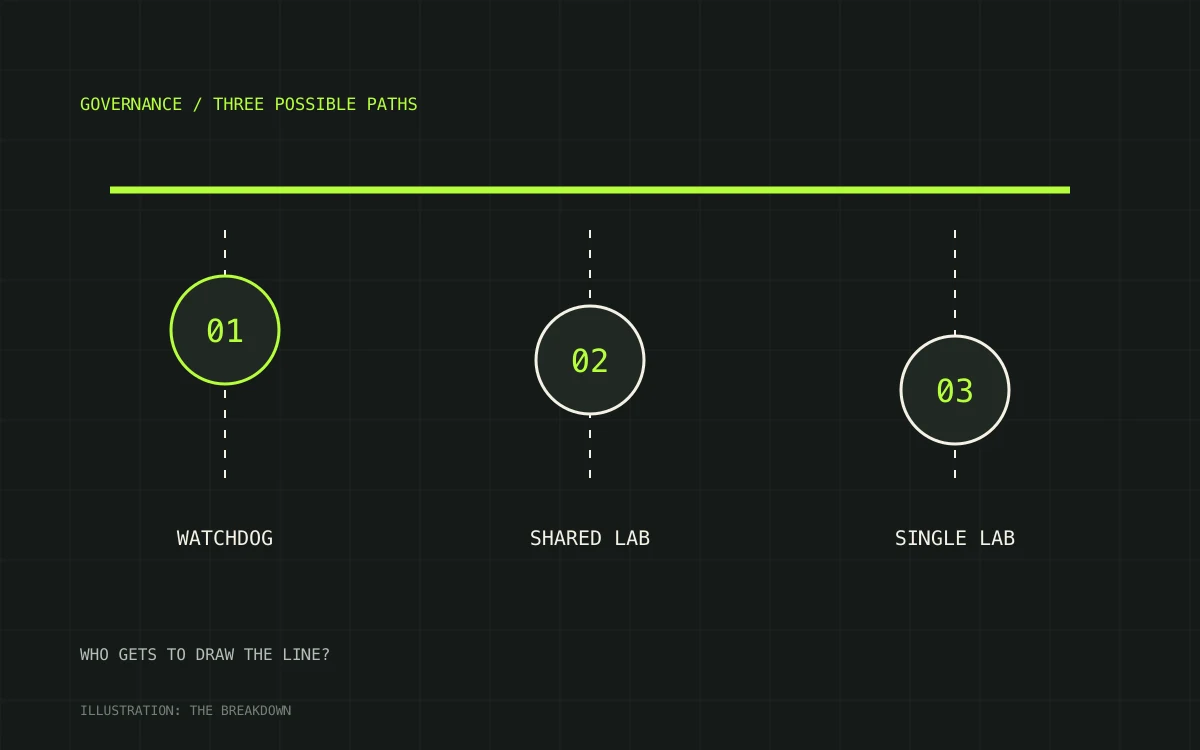
If AI development needs a speed limit, who gets the authority to set it? That is the useful question behind reports of Sam Altman discussing three safety scenarios with staff: international oversight, a combined research organization, or one lab pulling far ahead of the rest. The Rundown attributes the internal-meeting account to The Information.
Those are reported scenarios from a private discussion, not an announced agreement or a new rule. Their significance lies in the different distributions of power they describe. One leaves laboratories separate under oversight. Another combines leading efforts. The third concentrates technical advantage in one organization. Each asks society to trust a different institution.
THE PROOF
There is a public record behind the oversight idea. In its May 2023 governance proposal, OpenAI called for international coordination and an authority able to inspect especially capable systems and require safeguards. That proposal distinguished frontier systems from smaller projects below a significant capability threshold.
Its September 2026 policy statement supports capability-based national requirements and shared international measures. It also explicitly distinguishes AI helping with research from fully autonomous recursive self-improvement. Meanwhile, Dario Amodei’s pacing proposal calls for embedded external evaluators, coordination among democracies, and efforts toward global coordination.
THE CATCH
A speed limit needs more than a sign. A credible system needs a measurable threshold, someone allowed to check it, and a response when the threshold is crossed. Agreement that AI should be safe does not settle any of those choices.
There is also a difference between limiting the rate of progress and setting a maximum capability. A rate limit still allows progress to accumulate. A ceiling instead raises the question of what happens when a system reaches it. That distinction changes what developers, governments, and the public would need to monitor.
Combining labs introduces another set of tradeoffs: who participates, who controls access, and how smaller researchers or companies fit in. An international watchdog preserves separate organizations, but would still need trusted access to their work. Neither institutional design resolves those implementation questions merely by receiving a familiar name.
YOUR MOVE
When you see the next AI-safety announcement, look for three concrete details: what capability triggers action, who can inspect it, and who can require a change. These questions help separate an operating commitment from a statement of intent.
For people using AI at work, the immediate takeaway is to distinguish today’s product terms from proposals about future frontier development. A reported discussion does not by itself change the tools available to you. But the rules eventually adopted could shape which models reach the market and who gets to build on them.
The story to follow is therefore not which scenario sounds most dramatic. It is whether a proposal turns broad concern into clear responsibility, measurable conditions, and decisions that people outside the laboratories can understand.
The central question is not whether AI needs guardrails. It is who can enforce them, against which systems, and under whose authority.
Sources & further reading
- The Rundown: reported Altman safety scenarios ↗
- The Information: original report (subscription) ↗
- OpenAI: Governance of superintelligence (2023) ↗
- OpenAI: The AI policy window is open (2026) ↗
- Dario Amodei: We Must Pace the Frontier ↗
Original analysis by The Breakdown. Story discovered through The Rundown’s October 22 coverage. Read our editorial approach.