Mercury 3 promises faster AI. Will you actually wait less?
THE SHIFT
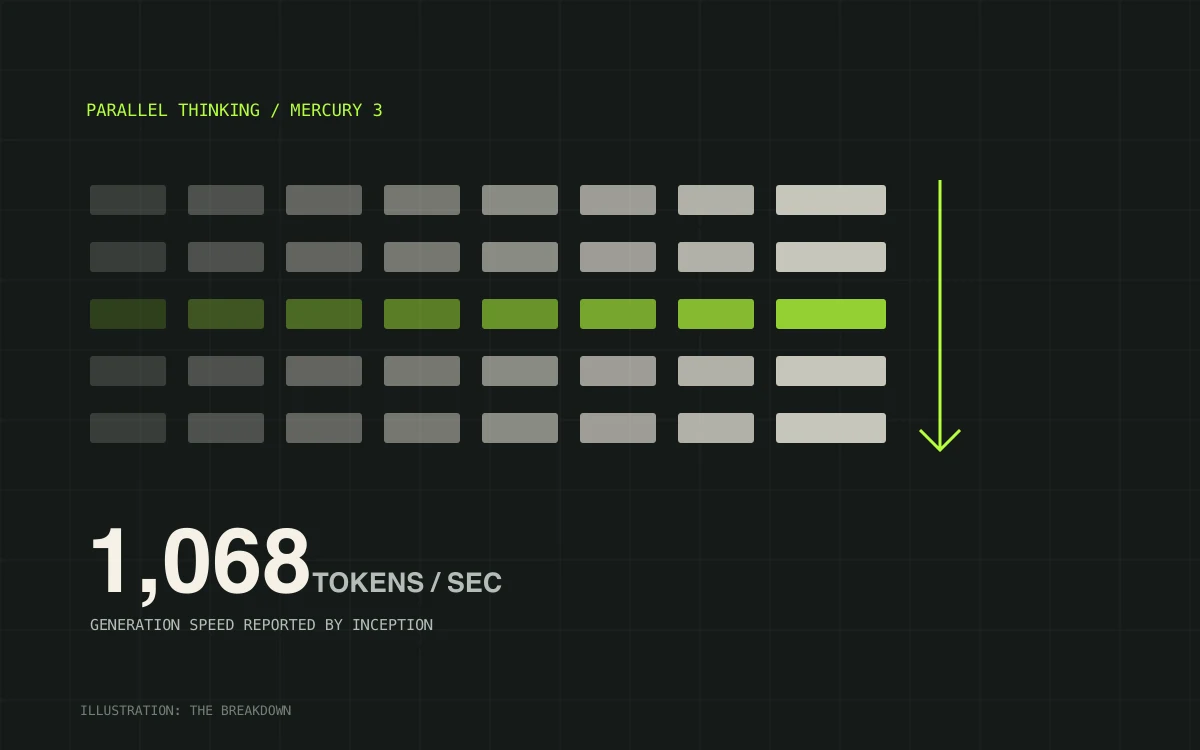
What if your AI assistant could keep up with the conversation instead of making you wait? Inception is pitching Mercury 3 around that experience. The company reports generation speeds of 1,068 tokens per second and points to tutoring, search, customer support, and browser agents as practical applications. Its announcement arrived on October 19.
The design takes a different route through language. Rather than producing every text fragment strictly in sequence, diffusion models predict multiple tokens in parallel and refine the result. Think of several parts of a draft taking shape together. Inception described the underlying approach in its Mercury research paper; that earlier research concerns the model family, not a separate evaluation of Mercury 3.
THE PROOF
One useful detail sits inside Inception’s published partner reports. Search company Octen reports a median generation time of 0.9 seconds, but a complete response time of 2.2 seconds. Both numbers describe its application, and their difference matters: text generation occupies only part of the user’s wait. Read the partner account.
Mercury is also accessible beyond a demo. Inception’s documentation provides a live API path and describes compatibility with existing developer libraries. That gives application builders a route to incorporate it; it does not mean every existing assistant will automatically become faster.
THE CATCH
A speedometer does not tell you when you will arrive. An assistant may spend time fetching documents, opening a website, calling another service, or correcting an answer. Improving one stage helps most when that stage is the bottleneck. A very fast reply that needs another attempt can still make a slow experience.
Price deserves the same practical lens. Inception’s listed rates are $0.20 per million input tokens and $0.70 per million output tokens, with a 50% launch offer displayed. Those are usage prices, not a promise about a finished application’s subscription charge. A budget based on promotional rates should also account for the regular rate.
YOUR MOVE
If you rely on AI for live conversation or repeated short tasks, watch for tools offering Mercury. Pay attention to the moment the answer becomes useful: does the exchange feel smoother, and can you act on the response? That is a more meaningful benefit than a generation counter alone.
If your current assistant already answers quickly, you do not need to switch because another model posts a bigger number. Choose around the task. For a tutor, clarity matters alongside timing; for an agent, finishing the right action matters alongside speed. The headline opens the conversation. Your actual workflow decides whether the change matters.
Less waiting is a compelling promise. Mercury’s real opportunity is making useful work feel immediate, not merely making text appear faster.
Sources & further reading
- Inception: Introducing Mercury 3 ↗
- Inception model pricing ↗
- Mercury research paper (2025) ↗
- Inception platform documentation ↗
- Discovery and background reporting: The Rundown ↗
Original analysis by The Breakdown. Story discovered through The Rundown’s October 22 coverage. Read our editorial approach.