NVIDIA: AI Is Helping Build the Chips That Run AI
Watch on YouTube ↗ · 82 seconds
Can AI help engineers make the chips that AI needs?
THE SHIFT
AI needs advanced chips, and chip manufacturing creates demanding engineering problems. NVIDIA’s November 3 update describes how accelerated computing, physics models, agents and digital twins are helping semiconductor companies investigate those problems. The useful change is in how engineers explore a decision before committing equipment, materials and time to a physical trial.
This is a feedback-loop story. Faster analysis can make it practical to compare more possibilities. It does not automatically establish that the production line makes more chips per hour, achieves better yield or delivers a cheaper finished device. Those are separate outcomes to measure.
Source: NVIDIA: AI Is Changing How Semiconductor Fabs Work — November 3, 2026 ↗
THE PROOF
Start with simulation. Engineers model interactions such as heat transfer, electrical behavior and mechanical stress. NVIDIA reports that COMSOL is accelerating relevant multiphysics simulations using its cuDSS library. It also describes Applied Materials using accelerated simulation and physics AI in process-development tools. The reported speedups belong to those specific computations and comparisons.
Physics prediction adds another layer. NVIDIA says Lam Research demonstrated plasma prediction using the PhysicsNeMo framework in milliseconds, compared with days for a full simulation. Plasma is used in semiconductor etching. A model trained to predict behavior can help explore process conditions without repeating the complete calculation every time. The distinction between a prediction and a full simulation is essential to interpreting that comparison.
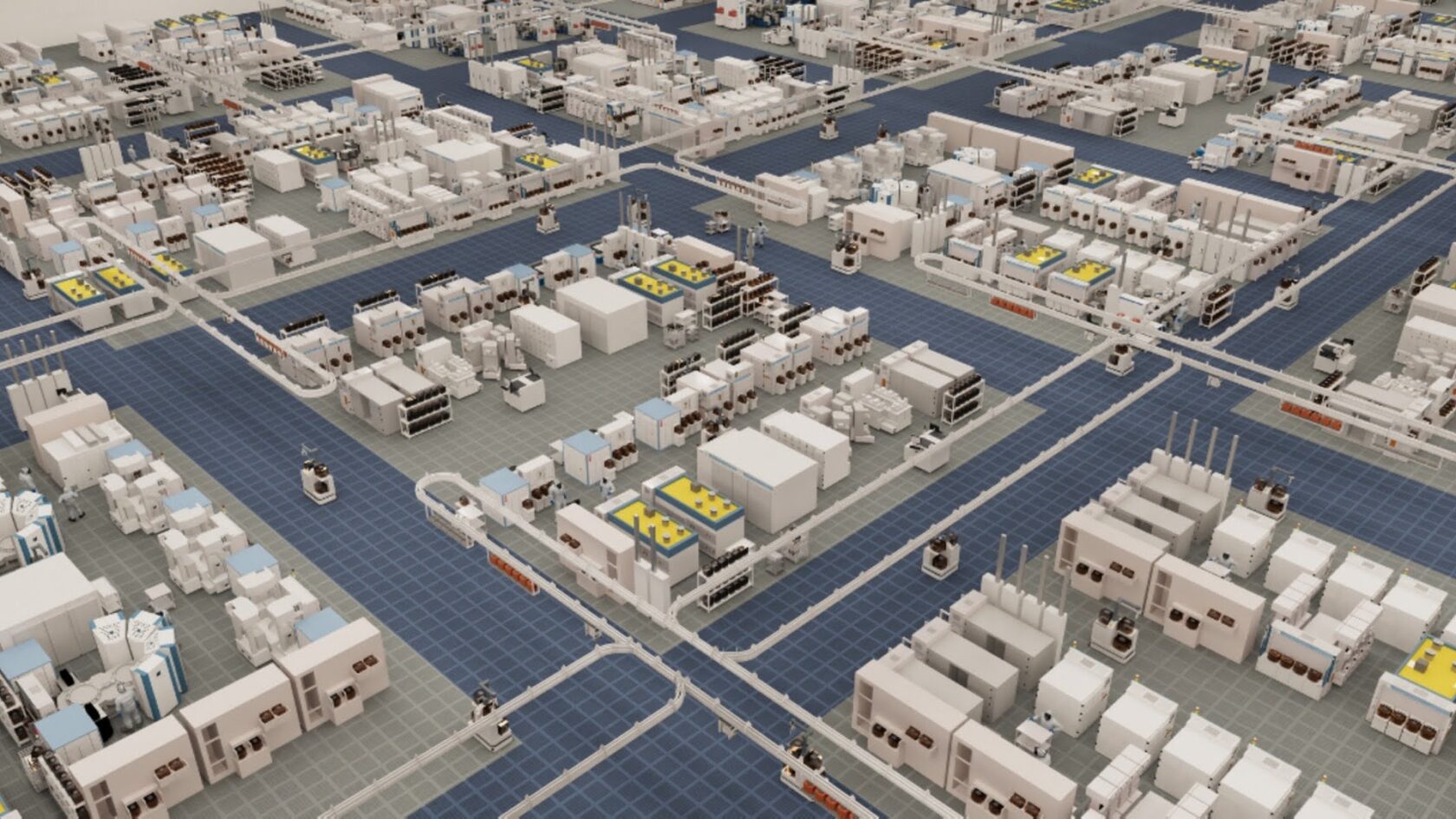
Then there is the factory’s digital twin. Applied Materials uses NVIDIA Omniverse libraries to build virtual factory environments for examining material movement, bottlenecks, layouts and operating strategies. NVIDIA also describes Advantest using NeMo Switchyard agents to help select AI models for test-floor tasks, with reported response times falling from hours to minutes.
Source: NVIDIA: AI Is Changing How Semiconductor Fabs Work — November 3, 2026 ↗
THE CATCH
A fast calculation is one part of a manufacturing workflow. A factory still operates under physical constraints, and a proposed change needs to be evaluated for practical use. The source presents engineers as directing the work and making the decisions. It does not establish a factory that independently redesigns and runs itself.
Keep the comparison attached to the result. Milliseconds for a learned prediction and days for a full simulation describe different computational paths. They do not mean that wafers move through every production step in milliseconds. Similarly, a faster model-selection task is not a measured increase in factory-wide throughput.
YOUR MOVE
When an AI manufacturing announcement leads with a large speedup, ask what got faster, what it was compared with and which quality checks remained. Then ask whether the reported result changes engineering iteration, prediction accuracy, yield, cost or output. Each question describes a different kind of progress.
The mechanism to watch is the loop: production information helps inform a model, the model helps evaluate a change, engineers choose the next physical step, and the results inform the following decision. Better support for that loop can matter even before a headline about production output becomes justified.
Faster engineering decisions can help improve factories. They are not the same as faster chip production.
Sources & further reading
- NVIDIA: AI Is Changing How Semiconductor Fabs Work — November 3, 2026 ↗
- Further reading: NVIDIA’s AI-built robot test worlds and their real-world gap ↗
- Further reading: How AI is changing manufacturing workflows ↗
- Further reading: Industry coverage ↗
Published by The Breakdown. How we report · Our source desk.