NVIDIA Omniverse’s Robot Demo Has a Real-World Catch
Watch on YouTube ↗ · 75 seconds
What does a robot’s success in a simulator actually prove?
THE SHIFT
When a robot succeeds inside a simulator, what has it actually demonstrated? NVIDIA’s October 29 showcase puts that question next to a second development: developers are directing AI agents to help build the simulation applications themselves. That moves part of the work from manually connecting each component toward instructing an agent, inspecting the result and guiding changes.
The distinction matters. An agent helping assemble a test environment is different from a robot independently mastering a physical workplace. The examples involve people directing development, reviewing outputs and deciding what to improve. The useful story is how those tools help construct and investigate a task—not a claim that human engineering judgment has disappeared.
THE PROOF
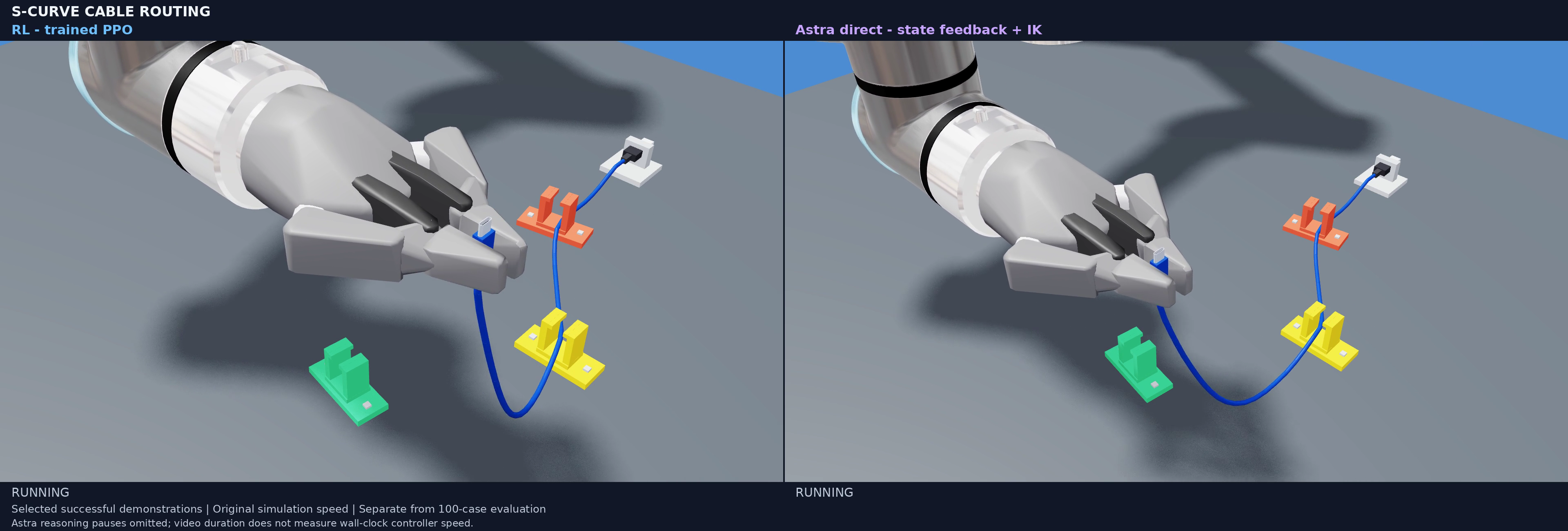
One NVIDIA example focuses on routing a flexible cable and aligning it with a connector. The source describes a developer using Astra with Isaac Lab, Newton physics and Omniverse rendering. The cable’s flexibility makes the task more involved than moving a rigid object between fixed points: the route and connector alignment both matter.
The accompanying official demonstration presents an RL-trained controller alongside an Astra path using direct state feedback and inverse kinematics. Its labels identify selected successful demonstrations. They also explain that reasoning pauses are omitted, so the displayed clip duration is not a measure of wall-clock controller speed. Those qualifications belong with the moving picture.
NVIDIA also shows an interactive humanoid warehouse simulator built under a developer’s direction. It is a separate example of constructing a physics-based environment and interface. It is not evidence that the cable controller has been deployed on a warehouse robot.
THE CATCH
For the cable experiment, NVIDIA says the controller receives information directly from the simulation. A physical system must work with information it can obtain through cameras and other sensors. The source identifies sensor-based information and testing a friction-held grasp as next steps. Those are concrete changes to the conditions under which the controller operates.
An analogy helps: practicing with the answer key visible can still teach something about solving a task, but removing that answer key changes what the solver has to infer. Here, the important question is which information the simulator supplies and how a real system would obtain a usable equivalent. That is an explanation of the gap, rather than a claim that every simulation is unrealistic or unhelpful.
YOUR MOVE
When evaluating a robot demonstration, ask three separate questions. Is the environment simulated or physical? What information reaches the controller? What does the footage establish about the task, and what remains to be checked under different conditions? Keep a successful selected clip separate from a success-rate claim or a speed comparison.
For teams building with these tools, define the task and its observable inputs before judging the result. Match the information used in the simulator to what a deployed system could obtain, then make the next experiment about that specific difference. A sharper test question is more useful than treating visual realism as a shortcut to physical reliability.
Building the practice world is progress. Crossing into the real one is another challenge.
Sources & further reading
- NVIDIA: How developers turn ideas into simulations with frontier AI agents — October 29, 2026 ↗
- Why world models matter for robots ↗
- More AI research explained ↗
Published by The Breakdown. How we report · Our source desk.