AIR Humanoid Robot: Would You Train Your Replacement?
Watch on YouTube ↗ · 45 seconds
What changes when doing a job also teaches a robot how to do it?
THE SHIFT
Imagine arriving for a shift and guiding a robot through the work you already know. The immediate output is a completed task. The second output is a record of how that task gets done. That is the tension behind AIR: productive work can also become the lesson that reduces future human operation.
Swiss startup Embodied AI unveiled AIR at Humanoid Europe in Munich on November 6. The company describes a factory robot that begins each job under human control, records those demonstrations and progressively learns the task. It says this typically takes about a month, with an operator remaining available for unfamiliar situations.
THE PROOF
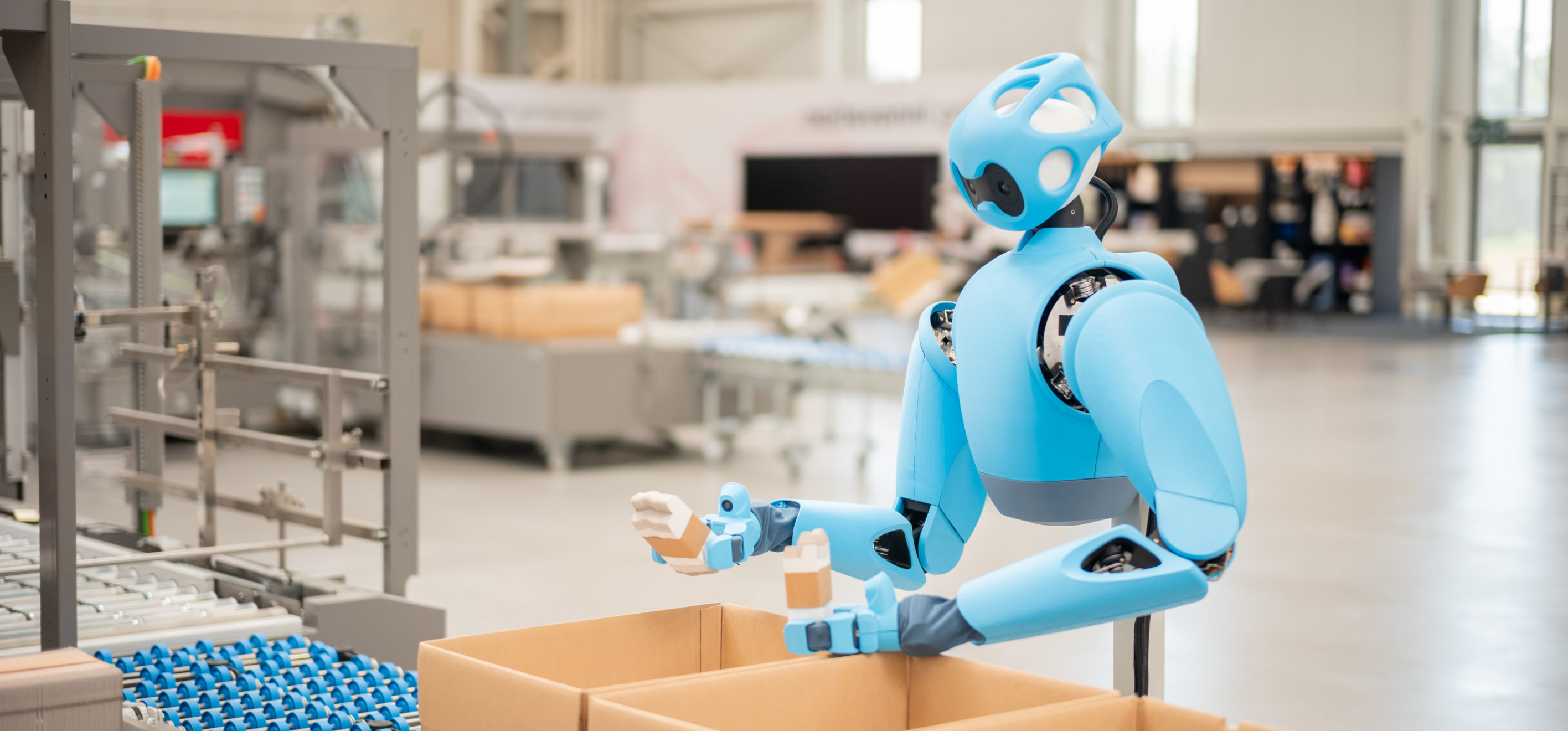
AIR has two arms and a wheeled base. Embodied AI puts motors, gearboxes and electronics in the torso, using tendons to move lightweight arms. The design aims to make contact more compliant. Wheels suit the flat factory environments the company is targeting. CE marking is planned for 2027; a design claim is not the same as completed certification.
The company’s official footage shows AIR handling small parts and working around shelves. Its website distinguishes AIR from Flex02, a separate two-arm industrial system using the same AI stack. That distinction matters when watching a montage: a successful manipulation clip from one platform does not establish the performance of another.
The learning loop is easier to understand as three stages: an operator performs the task, the system records demonstrations, and a learned policy attempts that task. Human support remains part of the operating model. The company also says skills learned by one robot can be used by another.
THE CATCH
A task is a bounded piece of a job. Picking a familiar part does not by itself cover a damaged component, a rearranged station or an unexpected person entering the workspace. The useful question is where the learned behavior ends and human intervention begins.
Embodied AI’s launch release reports a 98% cable-handling result from a customer proof of concept using its separate two-arm industrial cell. It should not be described as a factory-wide success rate for AIR. The company-hosted press document also discusses pilot results across its robots. These figures describe different scopes; combining them into one headline would erase the distinction that makes the numbers meaningful.
YOUR MOVE
If you are evaluating a factory robot, ask for the intervention rate alongside the task success rate. How frequently does an operator take over? Which changes require more demonstrations? What happens to throughput while the robot is learning? A month-long timeline becomes useful only when the task and operating conditions are specified.
For workers, the practical issue is who controls the training process. Ask what gets recorded, how demonstrations are used and how responsibilities change as autonomy increases. Those are questions for a deployment agreement and workplace discussion, rather than answers supplied by a product video.
The wider robotics story is moving from impressive isolated motions toward repeatable work. Our earlier reporting on Arda’s manufacturing AI provides another point of comparison: bringing intelligence into production requires attention to the workflow around the system, as well as the model or machine itself.
AIR’s most consequential idea is the learning loop: the work done today can train the robot that does more of it tomorrow. Whether that helps workers or changes their roles depends on the deployment, the task and the human support still required.
Sources & further reading
- Embodied AI launch release — November 6, 2026 ↗
- Embodied AI: product lineup, learning stack and official footage ↗
- Company-hosted AIR press document ↗
- Related: Arda and AI in manufacturing ↗
Published by The Breakdown. How we report · Our source desk.