Elon Musk’s Neuralink Gets FDA Approval for Pivotal ALS Brain Implant Trial: What It Really Means
Watch on YouTube ↗ · 68 seconds
Did the FDA approve Elon Musk’s Neuralink brain chip?
THE SHIFT
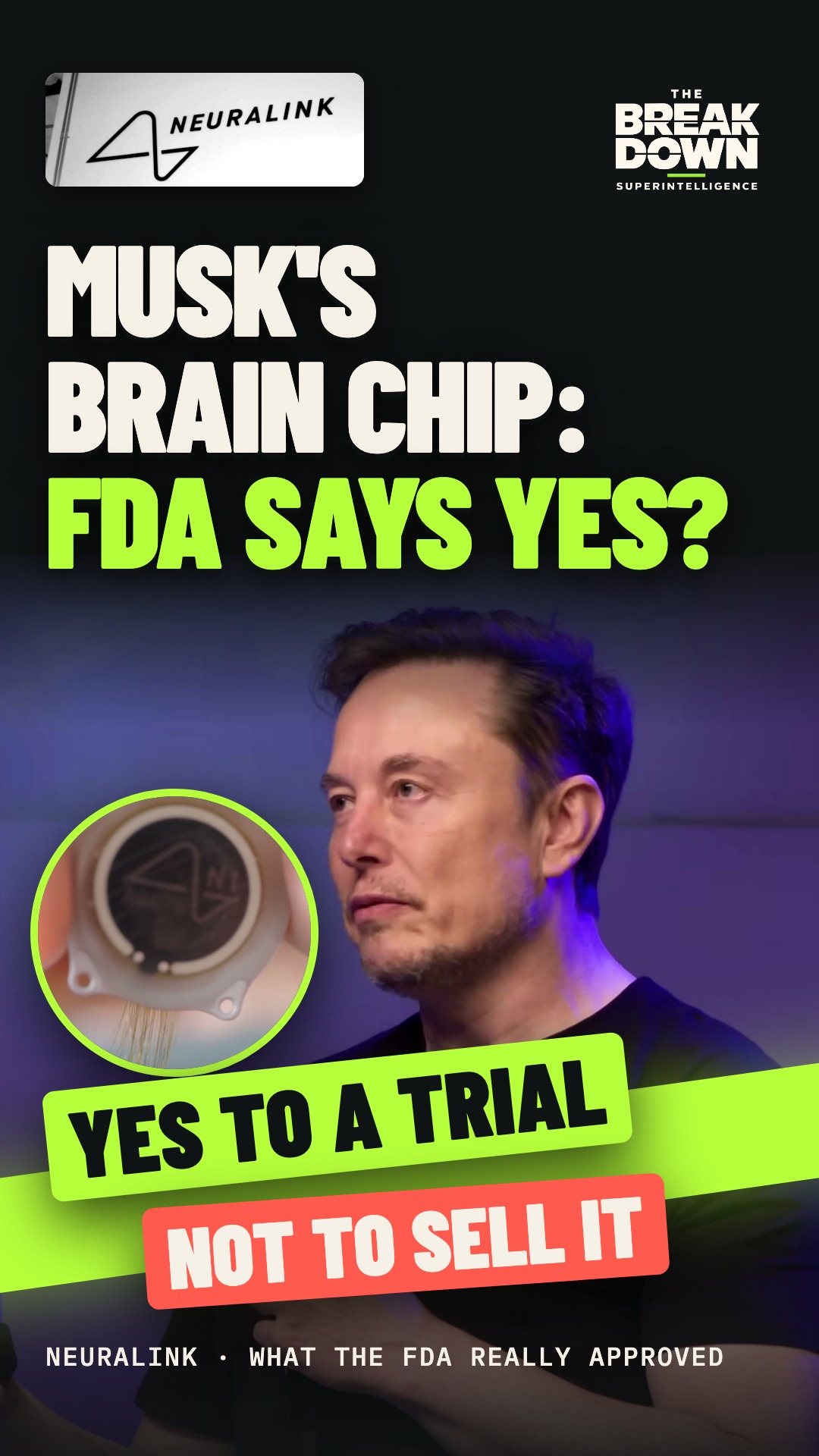
On November 25, 2026, Neuralink said the U.S. Food and Drug Administration had approved the LINK Pivotal Study, which the company calls “the first pivotal trial for an implantable brain-computer interface (BCI) in the United States.” The study is open to adults with severe paralysis caused by amyotrophic lateral sclerosis, or ALS, and enrollment has started.
The headline most people saw was that Elon Musk’s brain chip got FDA approval. That is not quite what happened. The FDA did not approve the implant for sale. It approved the trial that is meant to decide whether the implant can be sold.
Source: Neuralink: Neuralink Receives FDA Approval to Launch LINK Pivotal Study (Nov 25, 2026) ↗
THE PROOF
A pivotal trial is the last large study before a company asks the FDA to let it market a medical device. Neuralink says this one will “evaluate the safety and effectiveness” of its system, with “a focus on functional outcomes that improve independence in daily life,” and will keep checking the implant’s “long-term safety and reliability” across several clinical sites. Its trial page lists follow-up visits for 24 months after surgery.
The device is a coin-sized implant placed in the skull. Neuralink’s R1 surgical robot inserts its electrode threads, which are too fine to place by hand, into the part of the brain that controls the hand. Participants learn to move a cursor by imagining moving their hand, and from there they can use a computer.
The company says more than 30 people have received the implant in early feasibility studies in the United States, Canada and the United Kingdom, and that participants have used it to pursue higher education, play video games, create art and communicate with their families.
Source: Neuralink: Neuralink Receives FDA Approval to Launch LINK Pivotal Study (Nov 25, 2026) ↗
THE CATCH
Those early studies mainly asked whether the implant and the robot are safe and whether the system works at all. The pivotal trial asks the harder question: does it keep working, every day, for years, well enough to give people their independence back?
That is not a hypothetical worry. In May 2024 Neuralink reported that in its very first participant, “a number of threads retracted from the brain” in the weeks after surgery, reducing the number of working electrodes. The company says changes to its software then restored and improved his performance. A pivotal trial is where that kind of durability has to be shown across many patients, not one.
Neuralink has not published the size of the trial, the number of sites or a timeline. Approval of the study is also not a promise of approval of the device: the results still have to support a marketing application, and the FDA still has to accept it.
YOUR MOVE
If you or someone in your family lives with ALS, the trial is the news that matters: Neuralink says enrollment is open to U.S.-based adults with ALS through its patient registry, and the company describes a screening, surgery and two-year follow-up process on its trial page. Talk to your own doctors before deciding anything.
If you follow the technology, watch for the first published results on durability and daily use. Moving a cursor is no longer the milestone. Doing it reliably, at home, for years, is.
The FDA did not approve Elon Musk’s brain chip. It approved the exam. Moving a cursor already works; lasting for years is what Neuralink still has to prove. Pass that, and a brain chip stops being an experiment and becomes a product.
Sources & further reading
- Neuralink: Neuralink Receives FDA Approval to Launch LINK Pivotal Study (Nov 25, 2026) ↗
- Neuralink: Telepathy, device-control trial page (read Nov 26, 2026) ↗
- Neuralink: Technology (read Nov 26, 2026) ↗
- Neuralink: PRIME Study Progress Update — User Experience (May 8, 2024) ↗
- Engadget: Neuralink receives FDA approval for ‘pivotal’ brain implant trial in ALS patients (Nov 26, 2026) ↗
Published by The Breakdown. How we report · Our source desk.