Claude Fable 5.2: 1,000 AI Agents Built an Operating System
Watch on YouTube ↗ · 54 seconds
What changes when an AI coordinates a project instead of stopping at one answer?
THE SHIFT
Anthropic introduced Claude Fable 5.2 and Claude Mythos 5.2 on November 9, 2026. Its launch story focuses on technical projects that extend beyond a single answer: software systems, engineering work and coordinated teams of agents. The practical question is how an AI organizes a project and reaches a result that someone can inspect.
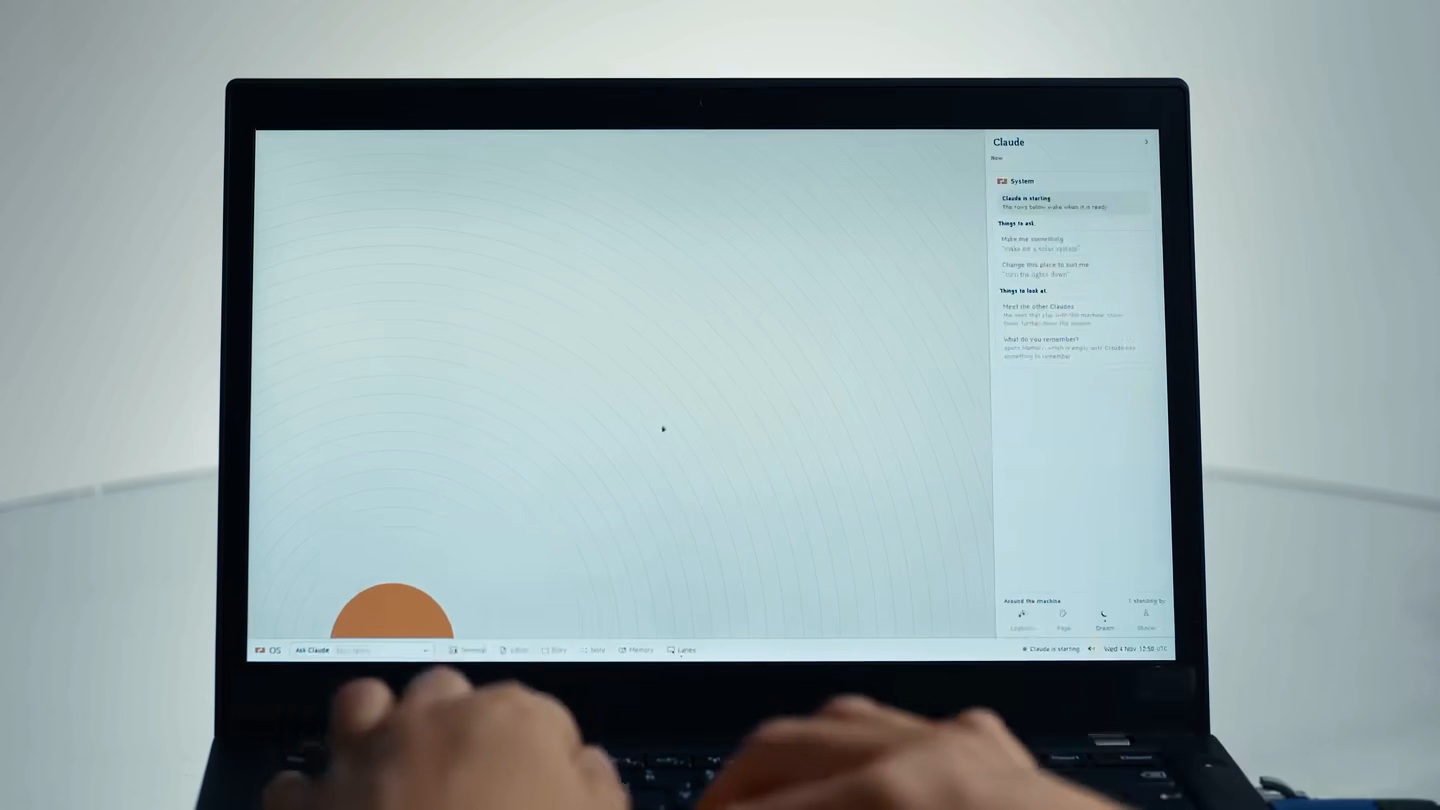
The company says its operating-system experiment used more than 1,000 subagents over eight days, starting from an empty folder. It reports that the resulting prototype boots on a laptop and includes drivers, file storage, windows and an installer. This is an experimental project described by Anthropic, rather than a promise that every user can reproduce it from a short request.
Source: Introducing Claude Fable 5.2 and Claude Mythos 5.2 — Anthropic ↗
THE PROOF
The official launch footage shows the operating system running, hardware design views and physical robot-arm demonstrations. The robot clips include a puzzle cube, a bottle cap, a gear and a drawing. They give the announcement concrete visual examples; the edited clips do not establish real-time task duration or a general reliability rate.
In its separate electronics research, Anthropic describes designs for a voice-assistant hub, a USB speakerphone and a handheld virtual pet. The project involved Diode, which designs and manufactures circuit boards. People manufactured and assembled the hardware. The company reports that all three devices worked without electrical modifications. The boards, enclosures and completed devices are distinct pieces of evidence in that workflow.
Another Anthropic research write-up describes a 1,000-agent team reproducing a formal proof of Fermat’s Last Theorem. Agents worked in separate sandboxes and shared progress through Git and a database. That is a different experiment from the operating system. It helps explain why coordination, task ownership and checking work matter when a team grows.
Source: Introducing Claude Fable 5.2 and Claude Mythos 5.2 — Anthropic ↗
THE CATCH
The 64.9% RoboDojo Sim figure belongs to a simulated two-arm robot benchmark, from Anthropic’s internal runs at Max effort. It is separate from the physical robot footage. Treating that number as the real-world success rate of the bottle-cap or drawing demo would mix different forms of evidence.
Fable and Mythos share the underlying model, but their access conditions differ. Fable includes cybersecurity and biology safeguards and is broadly available. Mythos is restricted to verified organizations through Anthropic’s programs. The model documentation also specifies 30-day data retention for Fable 5.2, with zero data retention requiring express authorization.
YOUR MOVE
Standard API prices are $8 per million input tokens and $40 per million output tokens. Optional fast mode is $16 and $80 respectively. A token rate does not tell you a complete project’s bill: repeated attempts, context and the number of agents affect the amount of work performed.
For a long project, define an inspectable result and intermediate checks. Keep a record of what changed, which checks ran and where a person approved the outcome. The useful comparison is the finished work and its cost, with enough detail to understand how it was reached.
Longer projects need coordination and human review. Judge the finished work, its cost and the checks behind it.
Sources & further reading
- Introducing Claude Fable 5.2 and Claude Mythos 5.2 — Anthropic ↗
- Claude can design electronic prototypes from start to finish — Anthropic ↗
- Safely scaling multi-agent teams with Claude Fable 5.2 — claude.dev ↗
- Claude Fable 5.2 model documentation ↗
Published by The Breakdown. How we report · Our source desk.